Many miners have turned on their Antminer S9 and been surprised: so few hashes, so many watts! But that’s where custom firmware creators come to the rescue. Forums are increasingly asking, “Which firmware is the most energy-efficient?” or “Is it worth reflashing to avoid breaking the bank on electricity?” This article is straightforward, with real numbers and fresh examples. We’ll discuss how different firmwares affect power consumption, compare modes, discuss the importance of temperature, and conclude with practical advice.
🎯 Why change the firmware at all?
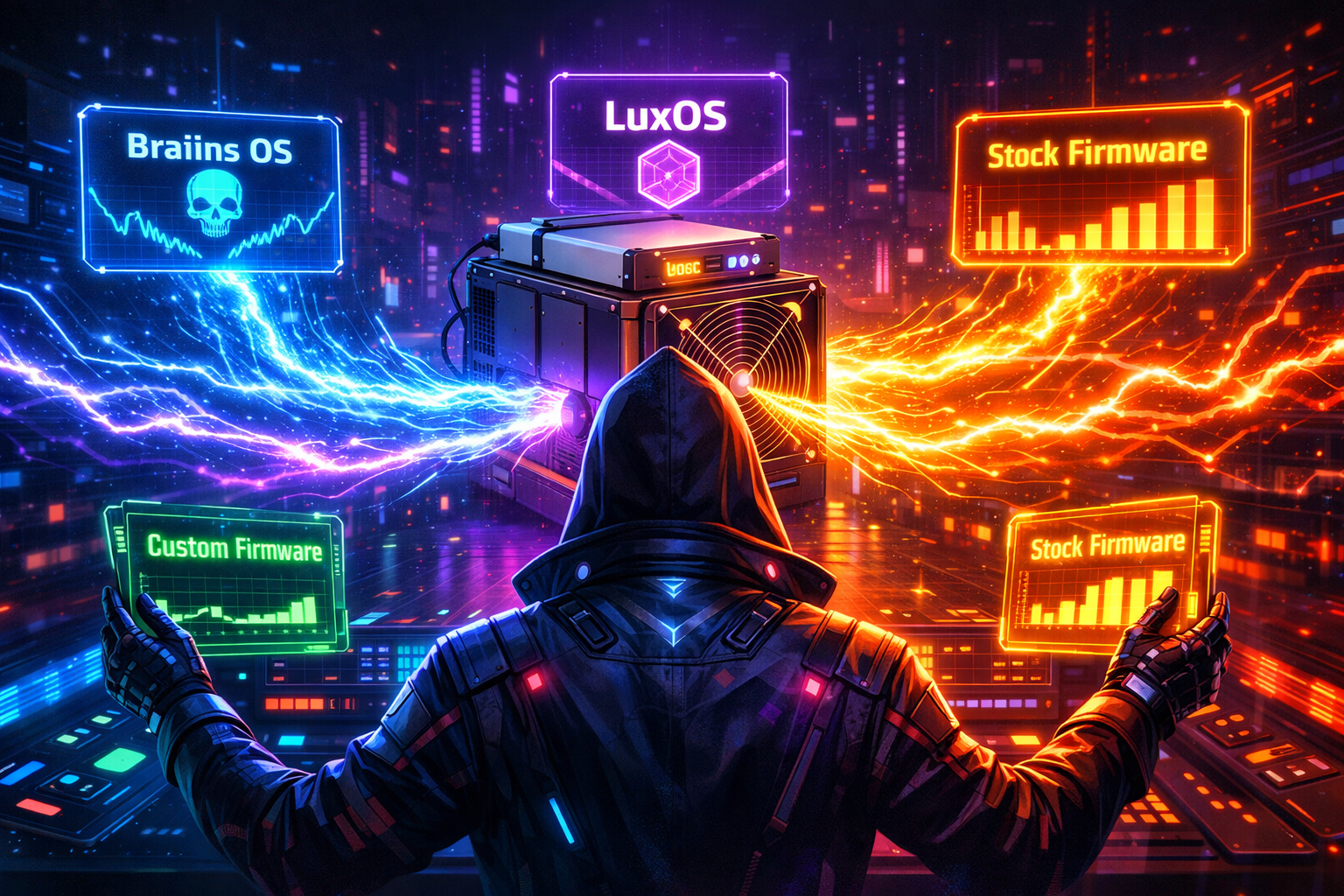
Popular ASIC miners come with stock firmware out of the box. Stock firmware is easy to learn, but not always optimal: its algorithms are tailored to average conditions, not a specific mining rig. Alternative firmware developers discover hidden chip capabilities, allowing you to adjust voltage and frequency, and select low power and overclock modes —these settings determine how many watts the device will draw and how long it will last.
Custom software increases performance and energy efficiency by “tens of percent .” This means the old S9 can produce a higher hashrate or run quieter and cooler. Of course, it requires a little experimentation, but the results are well worth the effort.
🧪 Practical example: Antminer S9 with stock and custom firmware
To be clear, let’s look at the Antminer S9 —an oldie still used on mining rigs. The stock firmware with ASICBoost enabled delivers around 13.5 TH/s with a consumption of 1380 W. The custom firmware from CrMi offers several modes:
- 17.5 TH/s – consumption about 1500 W ;
- 16.1 TH/s – about 1450 W ;
- 15 TH/s – about 1300 W ;
- 13.5 TH/s – only 1050 W ;
- 11.8 TH/s – 880 W.
Please note: a 13.5 TH/s hashrate can be achieved with a consumption of 1050 W , which is 330 W less than in stock mode. This reduction reduces your electricity bill without sacrificing income. The 11.8 TH/s option is suitable for those looking for a quiet home mining setup, as consumption drops to 880 W and heat output is reduced.
On the other end of the spectrum is S9K firmware 1.2.2 . It boosts the S9K to 17 TH/s at 1600 W. While power consumption increases, efficiency (watts per terahash) may be higher, making these modes attractive when power is cheap.
🌿 Saving without wasting energy: Low Power Mode and Low Power Enhanced
The developers aren’t limiting themselves to overclocking. The D-Central team compared three modes on the S9: Normal , Low Power , and Low Power Enhanced . The results are impressive:
| Mode | Hashrate | Consumption |
|---|---|---|
| Normal | ≈ 14.18 TH/s | ≈ 1459 W |
| Low Power | ≈ 13.88 TH/s | ≈ 1258 W |
| Low Power Enhanced | ≈ 9.87 TH/s | ≈ 914 W |
Switching to Low Power saves about 200W with virtually no loss in hashrate, and Low Power Enhanced reduces consumption even further. These modes are convenient for home mining or with high electricity bills. Of course, if the miner is overloaded, it’s best to revert to the stock firmware: the settings require a balance.
🧊 Why temperature plays an important role
Power consumption isn’t just a function of firmware, but also… the weather . An article on Hashrate Index about the LuxOS firmware explains: increasing air temperature leads to increased consumption , while cooling can reduce power by more than 10%. In hot weather, fans spin faster, the chips heat up, and the ASIC consumes extra watts. In cooler weather, you can safely overclock your hardware, especially if you use software tuning.
A similar approach is implemented in the Braiins OS firmware . The developers note that the Antminer S9 on Braiins OS can operate in the 400–1800 W range , and flexible settings allow you to choose the optimal point. For example, the device produces 13.09 TH/s at 1 kW , which corresponds to an efficiency of approximately 76 W/TH . For comparison, the S9’s standard parameters are 13.5 TH/s at 1160 W (approximately 86 W/TH). The difference is 160 W with virtually the same hashrate. This “undervolting” not only saves power but also reduces heat, vibration, and noise.
🔧 Why firmware can help you earn more
New models are appearing on the market (S19 XP, S21 Pro, Whatsminer M60 S), but many miners continue to use the S9, T9, L7, and other veteran models. At an electricity price of $0.12 per kWh, a typical ASIC consumes 1.5–3.5 kW , costing $130–300 per month . Reducing consumption by at least 20% can increase net profit by 40–60% . These figures were calculated by the authors of Cool-Mining .
In practice, the following helps:
- Custom firmware and auto-tuning. Cool-Mining recommends using Braiins OS+, Hiveon ASIC, or VNish: voltage regulation allows for a 15–20% reduction in consumption without any loss in power.
- Overclocking and undervolting. Reducing the voltage or frequency for each chip helps find the “sweet spot” between hashrate and wattage.
- Disabling inefficient devices. If an ASIC is consuming a lot of power, it’s sometimes more profitable to turn it off.
- Cooling optimization. Good ventilation reduces fan load, and immersion or liquid cooling reduces consumption by 8–10% .
- Renewable energy and seasonality. Solar panels can partially cover energy consumption, and heat from the farm can heat the house in the winter.
- Official updates from manufacturers. An example is Bitmain’s Overt ASICBoost update . It reduces power consumption by up to 13% and increases hashrate without affecting the Bitcoin protocol. Incidentally, CryptoMinerBros described this release in detail and emphasized that the savings are especially important for low-margin applications.
💬 What should a beginner do?
People often ask on forums and in chats: “Is it worth flashing an old S9?” The answer depends on your tariff and your goals. If electricity is expensive, switching to a custom Low Power Mode will reduce your bill. If you have cheap electricity and want to increase your income, choose 15–17 TH/s modes. Before flashing, be sure to:
- Make a backup copy of the original firmware;
- Check the compatibility of the model and boards;
- Watch the temperature: high heat kills ASIC faster than a typhoon;
- Choose firmware from reliable sources: Crazy‑Mining.org , Cool‑Mining.org , Crypto‑Mining.blog regularly publish instructions and reviews.
🛡️ And don’t forget about safety
Your hard-earned coins should be safe. Cool-Mining’s article suggests: when choosing a wallet, focus on reliability— offline key storage (Ledger, Trezor) is preferable to mobile apps . To avoid losing your mined Bitcoin or Kaspa wallet, check out Crypto-Wallets.org —they have detailed reviews of hardware and mobile wallets, instructions on protecting seed phrases, and staking tips. Whether you trust them or not is up to you, but storing millions in an exchange wallet isn’t a security measure.
🌍 A look into the future
Cryptocurrency is changing, and we are changing with it. Every year, manufacturers release new ASIC monsters: the Antminer S21 Pro delivers 235 TH/s at 3,300 W, and the Whatsminer M60 S delivers 226 TH/s at 3,440 W. These figures are already significantly higher than those of the S9. However, older devices don’t have to be consigned to the scrap heap: thanks to firmware updates, undervolting, and proper cooling, they can continue to generate income for a long time.
In a world where electricity costs are rising and the cryptocurrency market is becoming increasingly competitive, saving every watt is becoming a survival strategy. Custom firmware gives you freedom: you decide how much hash or heat you need and tailor your mining rig to your needs. Those looking ahead are already using alternative energy sources and remember that the key to mining isn’t making a quick buck, but maintaining sustainability for years to come.
📌 Conclusion
The question “Which firmware saves more?” doesn’t have a universal answer. But one thing is clear: custom software offers a wide range of settings , and choosing the right one can reduce power consumption by tens of percent. In this article, we’ve established that:
- Stock parameters are often far from optimal, and switching to custom firmware reduces consumption without losing hashrate;
- Low Power modes provide significant savings: on the S9, the difference was ~200 W ;
- Temperature and cooling affect consumption no less than firmware;
- Investments in energy-efficient equipment and creative strategies (solar panels, heat recovery) increase business sustainability.
Let this article serve as a starting point for your exploration. Experiment, compare, calculate, and share your experiences—mining thrives on curiosity and courage.
Read more:
 How to reduce mining rig energy consumption, increase ROI and efficiency
  ANTMINER FIRMWARE: official firmware for ASICs
  Mining Laws and Regulations in 2025: Russia, EU, and the US
  AwesomeMiner (Crack): Download CPU/GPU/ASIC/FPGA Miner for Windows/Linux
  ASIC Mining in 2026: What’s More Profitable to Mine and How to Increase Profits
  Undervolting GPUs: Reducing Power Consumption During Mining 🚀
  ASIC Miner Maintenance and Repair: A Beginner’s Guide
  Home oil mining farm for heating premises